

Spirit Crossing Mobile Review: Cozy Adventure Game for Relaxed Play
Spirit Crossing is a mobile adventure title that focuses on calm exploration, light storytelling, and steady progression rather than fast-paced mechanics. Released with a clear intention to attract players who prefer slower gameplay loops, it combines elements of life simulation, environmental puzzles, and narrative discovery. This review examines how the game performs on mobile devices in 2026, what systems it offers, and whether it maintains long-term engagement without relying on aggressive monetisation.
Gameplay Structure and Core Mechanics
At its core, Spirit Crossing revolves around exploration and interaction with a semi-open world filled with small objectives rather than strict missions. Players move through different regions, each designed with distinct visual themes and subtle environmental storytelling. Instead of constant combat or competition, progression depends on solving simple puzzles, gathering resources, and unlocking new paths through observation.
The control scheme is adapted well for mobile screens. Movement is responsive, and interactions are context-based, which reduces clutter on the interface. This makes the game accessible even for players who are not familiar with traditional adventure titles. Most actions require only a few taps or swipes, which is important for shorter play sessions.
Another notable aspect is the absence of pressure mechanics. There are no timers forcing quick decisions, and failure does not significantly punish the player. This design choice supports a more relaxed pace, allowing users to engage with the environment at their own rhythm, which aligns with current trends in mobile gaming focused on comfort and low stress.
Progression System and Player Motivation
Progression in Spirit Crossing is built around unlocking new areas and gradually expanding the available activities. Instead of level-based advancement, the game uses a discovery-driven system where players gain access to new content by completing environmental tasks or interacting with key characters.
There is also a light crafting system that encourages collecting resources scattered across the map. While not overly complex, it adds a layer of purpose to exploration. Items created through crafting often help solve puzzles or open alternative routes, reinforcing the loop between exploration and progression.
Daily activities and optional side objectives provide additional motivation without becoming intrusive. These elements are designed to extend playtime naturally rather than forcing repetitive grinding, which is often a concern in mobile titles.
Visual Style and Audio Design
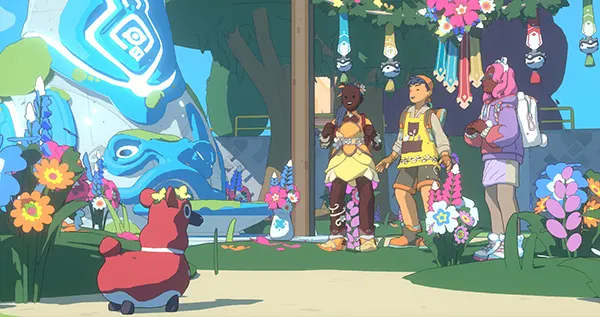
Spirit Crossing adopts a soft, stylised art direction with muted colours and smooth animations. The environments are not overloaded with detail, but they feel cohesive and carefully structured. This approach ensures stable performance on a wide range of mobile devices, including mid-range smartphones.
Lighting plays an important role in creating atmosphere. Day and night cycles subtly affect how locations look and feel, encouraging players to revisit areas at different times. Transitions between zones are seamless, which helps maintain immersion during longer sessions.
The sound design complements the visual style effectively. Background music is minimalistic, often using ambient tones rather than strong melodies. This prevents fatigue during extended play and supports the calm tone of the game.
Performance and Optimisation on Mobile Devices
From a technical perspective, Spirit Crossing is well-optimised for mobile platforms. Load times are short, and frame rates remain stable even on older hardware. The developers appear to have prioritised efficiency over high-end graphical effects, which benefits overall accessibility.
Battery consumption is moderate compared to similar adventure games. This is partly due to the restrained use of particle effects and simplified physics systems. Players can expect longer sessions without significant impact on device temperature or battery life.
Touch input is consistent, with minimal delay between action and response. This is particularly important for puzzle interactions, where precision matters more than speed. The interface also scales well across different screen sizes, from compact phones to larger tablets.
Monetisation Model and Long-Term Value
Spirit Crossing follows a hybrid monetisation approach that combines optional purchases with a free-to-play base experience. Players can access the majority of content without spending money, which aligns with expectations for fair mobile game design in 2026.
In-app purchases mainly focus on cosmetic items and small convenience boosts rather than gameplay advantages. This reduces the risk of imbalance and ensures that progression remains consistent regardless of spending. Importantly, there are no aggressive prompts interrupting gameplay.
Advertisements are limited and typically optional. Players may choose to watch ads in exchange for minor rewards, but these are not required to progress. This approach reflects a broader shift in the mobile industry towards less intrusive monetisation systems.
Replayability and Content Updates
Replayability in Spirit Crossing depends largely on exploration and completion. While the main progression path can be finished within a reasonable timeframe, additional content encourages players to revisit locations and uncover missed interactions.
The developers have introduced periodic updates that add new regions and seasonal events. These updates are not overly frequent but provide enough variation to maintain interest over time. Importantly, they tend to expand existing systems rather than replacing them.
Community feedback appears to influence development decisions, particularly in terms of quality-of-life improvements. This ongoing support suggests that the game is intended as a long-term project rather than a short-lived release, which adds to its overall value for mobile players.
RECOMMENDED GAMES
-
 Best Casino Simulators for PC: Vegas Style Games Without Real Stakes
Casino simulators for PC offer a way to enjoy the …
-
 Azur Promilia Review: A Fantasy RPG Built for Mobile Players
Azur Promilia is one of the most discussed mobile RPG …
-
 Kingdom Rush 5: Alliance – Wukong’s Journey: The Return of a Legend...
The Kingdom Rush franchise has long been regarded as one …
-
 Destiny: Rising — A Mobile Sci-Fi RPG Shooter
“Destiny: Rising” has emerged in 2025 as one of the …