

Servant of the Lake: How an Atmospheric Puzzle Game Blends Investigation, Riddles and a Gradually Revealed Story
Servant of the Lake takes a familiar point-and-click idea and gives it an unusually effective narrative purpose. Released by Rusty Lake on 13 August 2026, the game places the player in the role of a newly hired servant at the Vanderboom estate, where an apparently ordinary weekend of household duties soon develops into something far stranger. Preparing food, cleaning rooms, helping family members and arranging objects are rarely just chores. Each task creates an excuse to inspect another corner of the house, notice another disturbing detail or understand a little more about the Vanderbooms and their alchemical ambitions. Rather than separating puzzles from storytelling, Servant of the Lake makes the two depend on each other. Progress comes from paying attention to the estate, recognising relationships between objects and accepting that even the most mundane request may lead somewhere unexpected.
A Servant’s Routine Turns the Vanderboom Estate into a Puzzle
The premise works because the player arrives at the house as an outsider. Aldous and William Vanderboom already have their own routines, plans and family history, but the servant initially knows very little about them. The job therefore provides a natural reason to move through the property and interact with its contents. The opening sequence establishes this approach immediately. Before the servant can simply walk through the door and begin working, small practical problems have to be solved around the carriage and courtyard. Cups, a horse, a coin and objects found nearby all become part of a short chain of actions. None of these tasks requires complicated rules, yet together they teach the central principle of the game: look carefully before assuming that something is merely decorative.
Once inside, household work becomes the main structure for progression. The player prepares food, attends to family members, deals with laundry and personal requests, and eventually becomes involved in tasks that are much less conventional. Rusty Lake uses this routine to make interaction with the house feel justified rather than arbitrary. A bedroom is not simply another puzzle room waiting to be completed; it belongs to a particular person whose needs determine what the player should be looking for. The kitchen contains ingredients because meals have to be prepared, while portraits, cupboards, boxes and furniture can all contain information needed somewhere else. The result is a house that feels like a lived-in location even when its inhabitants behave in increasingly unsettling ways.
This arrangement also prevents the story from becoming dependent on long explanations. Servant of the Lake rarely needs to stop the action simply to explain what the Vanderboom family represents. The player learns through repeated contact with their habits, possessions and relationships. Objects that initially seem insignificant can later gain meaning, while an ordinary domestic request can reveal an unexpectedly macabre side of the household. That contrast is particularly important to the atmosphere. The servant is expected to continue working even when events become disturbing, creating a sense that unusual behaviour is normal within this family. The game therefore builds tension not by constantly increasing the scale of danger, but by making increasingly strange situations part of the protagonist’s everyday duties.
Why Everyday Tasks Make the Puzzles Feel More Natural
Many puzzle adventures place locks, symbols and mechanisms in front of the player simply because the genre requires obstacles. Servant of the Lake usually gives those obstacles a practical reason to exist within the current task. Preparing Aldous’s breakfast, for example, involves finding ingredients and understanding how they should be used before the meal can be completed. Another part of his morning routine asks the player to pay attention to a small figure in the room and reproduce its movements. Elsewhere, visual arrangements, family portraits and household objects provide clues that only become useful after the player has properly examined the surrounding space. The puzzles still follow the surreal logic associated with Rusty Lake, but they remain connected to what the servant has actually been asked to do.
The variety is equally important. Servant of the Lake does not rely entirely on numerical combinations or one recurring type of logic test. Some problems are based on observation, some on ordering objects correctly, some on matching visual information, and others require the player to work out which item should be used in a particular situation. Later sequences become more elaborate as the Vanderbooms’ experiments move closer to the centre of the story. This gradual shift keeps the early sections accessible while giving later puzzles more narrative weight. The player first learns how the house communicates information and only then faces stranger chains in which clues may be distributed across different rooms.
The best approach is therefore not to treat every screen as a collection of items that must be tapped at random. Servant of the Lake rewards a slower reading of its environments. A pattern on a picture, the position of an object, a note, a repeated symbol or a peculiar animation can all matter. Because these clues are usually presented visually rather than through lengthy instructions, solving a puzzle often produces a satisfying moment of recognition. The answer feels as though it was already present in the room and simply needed to be noticed. This style makes the game approachable without making it passive: the rules are rarely difficult to understand, but attention remains essential.
Atmosphere Comes from the House, Its Inhabitants and Their Strange Behaviour
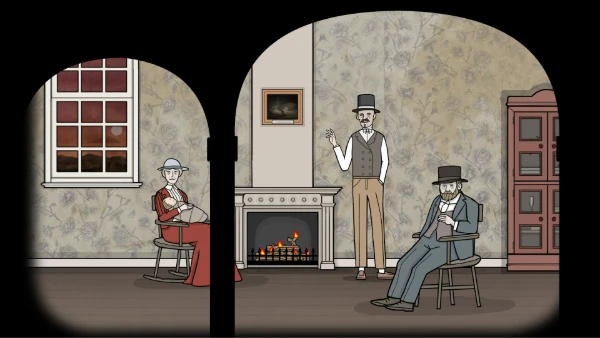
The Vanderboom estate is more than a backdrop for the puzzles. Its rooms establish the tone of the entire game through hand-drawn artwork, restrained animation and a deliberately old-fashioned interior. The house belongs to the same family history that shaped Rusty Lake: Roots, but Servant of the Lake presents it from a different perspective. Instead of following generations of Vanderbooms across a family tree, the player spends a concentrated period inside their home while working for them. That narrower viewpoint makes individual rooms and routines more important. Corridors, bedrooms, the kitchen, outdoor areas and work spaces gradually become familiar, yet familiarity does not make them comfortable. The more the servant learns about what happens there, the more threatening ordinary surroundings can appear.
The characters play a major part in that effect. Aldous and William Vanderboom are central figures in the wider Rusty Lake chronology, while Alexandra adds another important part of the family history. Servant of the Lake takes place decades before the events shown in Rusty Lake: Roots and focuses on a period in which the family’s alchemical interests are already shaping daily life. The player does not observe those interests from a safe historical distance. As the servant, they are expected to assist with requests, prepare for visitors and deal with the consequences of decisions made by the household. Being employed by the family creates an unusual relationship between protagonist and characters: refusing to participate is not how progress works, so the servant is repeatedly drawn further into their affairs.
This creates a particular kind of unease that differs from conventional horror. The game can be grotesque and dark, but it does not depend on constant pursuit or sudden threats. Much of its tension comes from waiting to see where an apparently simple instruction will lead. A request to prepare something, clean something or help someone may begin harmlessly before taking a disturbing turn. Because the visual style remains controlled and almost storybook-like throughout these changes, the strange events become even more noticeable. Servant of the Lake allows unsettling images to sit beside ordinary domestic details instead of signalling every frightening moment in advance.
Sound and Visual Detail Support the Slow-Burning Mystery
The soundtrack strengthens this atmosphere without competing with the puzzles for attention. Composer Victor Butzelaar, who previously worked on Rusty Lake: Roots, returned to create the music for Servant of the Lake. The score was designed around the Vanderboom estate and its different rooms, with individual pieces connected by a common musical identity. This suits a game in which players repeatedly move through familiar locations while the meaning of those locations changes. Music can make a room feel calm during one task and much less reassuring once later events have added new context. Sound design similarly gives small interactions a physical quality, helping the house feel less like a series of static puzzle screens.
Visual storytelling is just as important. Rusty Lake does not fill every room with obvious clues, so seemingly unimportant objects deserve attention. Portraits are particularly significant because the Vanderboom family itself is at the centre of the mystery. Their placement reinforces the idea that the servant has entered a household with a history that began long before their arrival. Other details work on a smaller scale: unusual objects, changes in a room, possessions associated with a particular character and items that appear again in another context can all contribute to the player’s understanding. The game rarely needs a large information panel when a carefully placed object can make the same point more effectively.
That visual restraint also supports the puzzle design. Important information is frequently part of the environment rather than isolated in a dedicated clue screen. Players gradually learn to distinguish between background decoration and details that might have a practical purpose, although the game deliberately blurs that boundary. A small figure can provide an instruction. A portrait can contain information needed elsewhere. Furniture may conceal an object required for another task. This creates a consistent relationship between atmosphere and interaction: paying attention to the art is not merely a way to appreciate the setting, but one of the main ways to understand how to proceed.
The Story Is Revealed Through Three Days of Increasingly Unusual Work
Servant of the Lake is structured around a three-day stay at the Vanderboom estate. That limited period gives the story a clear rhythm. The servant arrives with a job to perform, learns the routines of the house and then becomes involved in increasingly serious family matters as the weekend continues. The first day establishes characters and expectations through relatively recognisable duties. Later tasks place greater emphasis on the Vanderbooms’ unusual interests and the consequences surrounding them. Because each new stage builds on people and locations the player already knows, the growing strangeness feels like an escalation of the same situation rather than a series of disconnected episodes.
The gradual approach is especially effective for players who already know the Rusty Lake series. Servant of the Lake returns to the period of Aldous and William Vanderboom and provides additional context for characters whose importance extends beyond this single game. At the same time, knowledge of previous releases is not required simply to understand the servant’s immediate situation. The story begins with a clear role, a house full of people who need assistance and tasks that show the player what to do next. Connections to the larger chronology add another layer for long-time followers, but the central experience still works as a self-contained mystery about surviving several days in a very unusual household.
Much of the narrative is therefore assembled by the player rather than presented all at once. Conversations, chores, experiments, rooms and family interactions provide separate pieces of information. A character who initially seems eccentric may become more understandable after another event reveals what they are trying to achieve. An object can acquire a different significance when its relationship to the Vanderboom story becomes clearer. The game trusts players to remember these details and connect them over time. This is why investigation and storytelling feel inseparable: moving forward physically through the estate also means moving forward in the player’s understanding of the family.
How Servant of the Lake Fits the Wider Rusty Lake Story
Rusty Lake describes Servant of the Lake as taking place decades before Rusty Lake: Roots, making it a prequel rather than a continuation of the later Vanderboom family events shown there. This choice allows familiar names and themes to return without simply repeating the structure of Roots. Aldous and William are seen during an earlier stage of their story, while Alexandra receives a more direct presence than she had in previous games. The servant’s viewpoint is particularly useful because it places the player close enough to witness important events while still allowing the Vanderbooms to remain mysterious. The protagonist is an employee entering an established family situation, not a relative who already understands its rules.
References to the wider series are handled as part of the setting rather than as a substitute for the main plot. Players familiar with Rusty Lake can recognise recurring ideas connected with alchemy, transformation, family history and the unusual relationship between life and death. Newcomers, however, can follow the immediate sequence of duties without needing to memorise earlier games. The story provides enough context to understand that the Vanderboom household is pursuing dangerous and unusual goals. Previous knowledge changes how certain details are interpreted, but it is not required to understand why the servant should be cautious about the people giving the orders.
By the end of the three-day assignment, the strongest impression comes from how tightly the game combines its separate elements. The house gives the player somewhere meaningful to investigate, domestic work creates reasons to interact with its rooms, puzzles turn observation into progress, and each completed task reveals another fragment of the Vanderboom story. The hand-drawn imagery and Victor Butzelaar’s soundtrack maintain the unsettling tone while the escalating duties move the servant from ordinary housekeeping towards much darker responsibilities. Servant of the Lake succeeds because these parts rarely feel independent from one another. Solving a puzzle is usually also an act of investigating the estate, and investigating the estate is how the story gradually becomes clear.
RECOMMENDED GAMES
-
 Best Casino Simulators for PC: Vegas Style Games Without Real Stakes
Casino simulators for PC offer a way to enjoy the …
-
 Azur Promilia Review: A Fantasy RPG Built for Mobile Players
Azur Promilia is one of the most discussed mobile RPG …
-
 Kingdom Rush 5: Alliance – Wukong’s Journey: The Return of a Legend...
The Kingdom Rush franchise has long been regarded as one …
-
 Destiny: Rising — A Mobile Sci-Fi RPG Shooter
“Destiny: Rising” has emerged in 2025 as one of the …